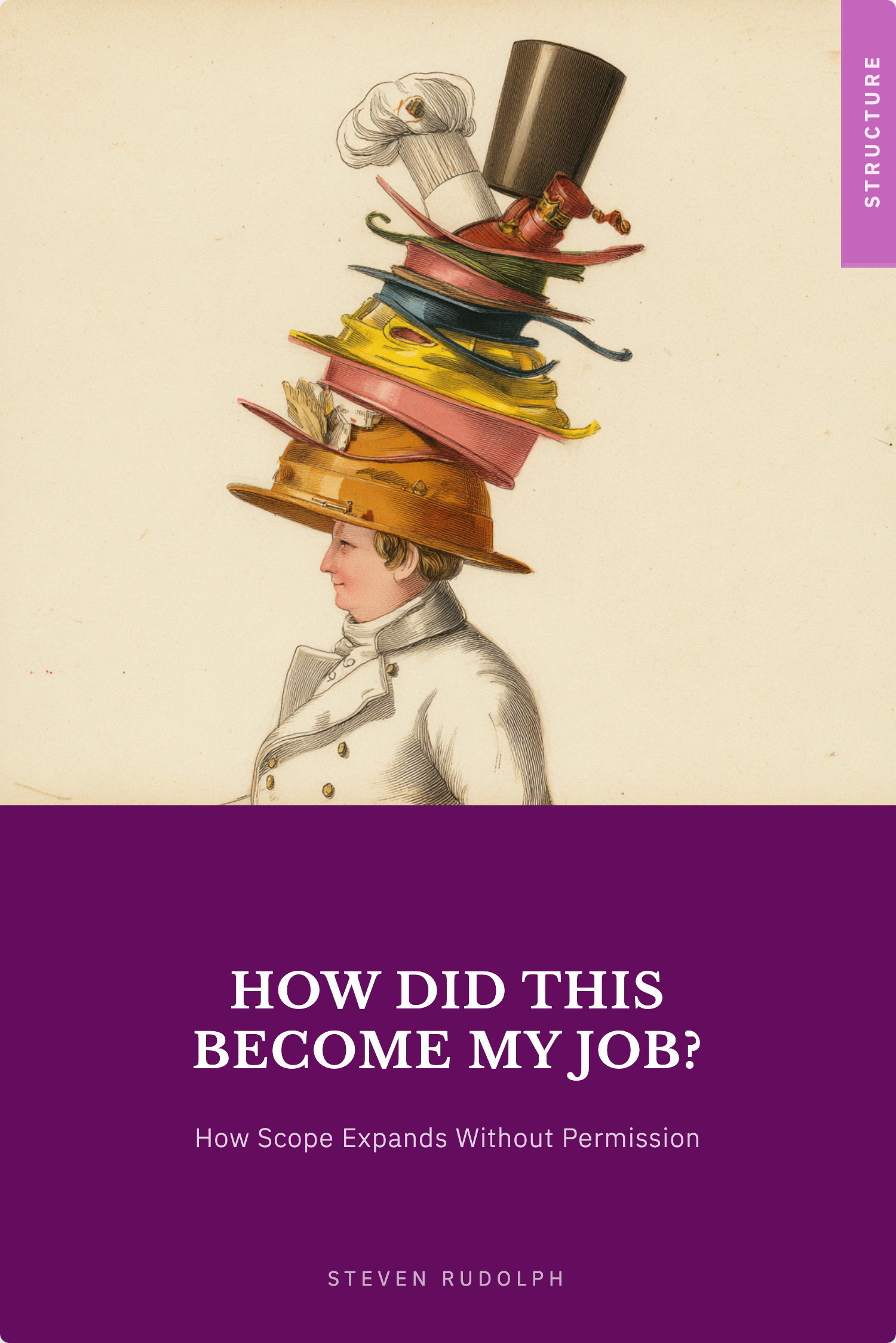
How Did This Become My Job?
How Scope Expands Without Permission
Nobody assigned it to you. Nobody asked. It just... accumulated.
You started with a clear role. Then you noticed something wasn't getting done, so you did it. Then something else. Then someone left and their work drifted to you. Then a process needed someone to own it and you were already adjacent. Now you're carrying functions that were never part of your job—and everyone treats them as yours.
This isn't about poor boundaries or inability to say no. Work migrates to one person through five pathways: nobody else is assigned, work gradually accumulates without tracking, work exists but nobody notices it's happening, you're fastest so you do it, and the role becomes part of your identity. "Just say no" doesn't work because the setup keeps routing work to you.
This book gives you 18 moves across 5 move families to name what you're carrying, figure out where it should structurally belong, give it back through a transfer protocol, and prevent it from migrating again. The key tools are the Function Inventory, the Ownership Map, and the Return Plan.
What's Inside
- You Didn't Agree to This — Why "you do too much" is the wrong frame—scope expanded by default
- How Functions Migrate — The five migration pathways: nobody assigned it, work accumulates untracked, work is invisible, you're fastest, the role becomes your identity
- Why "Just Say No" Doesn't Work Here — No, delegation, boundaries, reduced competence, leaving—and why all five fail
- Name What You're Carrying — Produce the Function Inventory diagnostic
- Map Where It Belongs — Ownership mapping: where every accreted function should live
- Give It Back — Transfer protocol, competence transfer, transition design
- Stop It From Coming Back — Temporary work architecture and migration prevention
Who This Is For
- Anyone whose job description bears no resemblance to what they actually do
- People who keep absorbing other people's work because no one else steps up
- Leaders whose role has expanded far beyond its original scope without anyone deciding it should
- Anyone who's tried setting boundaries and watched the work come back anyway
What Shifts After Reading
You stop blaming yourself for carrying too much and start seeing how work migrated to you by default. The question changes from "Why can't I say no?" to "What am I carrying that has a structural home somewhere else?"
You'll have a Function Inventory naming everything you carry, an Ownership Map showing where each function should belong, and a Return Plan with transfer protocols that give work back—not by confrontation, but by making clear where the work should live and putting it there.